
Mercedes E 200 2013 CDI Automatic (W212)
Mercedes E class 2013 2.1 diesel description
Sedan Mercedes E 200 2013 CDI Automatic has been produced from 2013 to 2016. It has four-cylinder diesel engine with displacement of 2.1 litres, which produces power of 136 horsepower at 2800 rpm and torque 360 Nm (Newton metres) on 1600 revolutions per minute.
This 4-cylinder 16-valve engine camshaft is driven by chain (What is an engine chain and belt? ). Engine has Common Rail fuel system and IHI / BorgWarner turbine. Engine versions compliant with Euro 5 and Euro 6 emission standards available. Average engine life expectancy (mileage before serious repairs are needed) is from 250 000 to 420 000 kilometres. It is important to remember that engine life is highly dependent on regular maintenance and the quality of the oils and fuels used.
More engine specs
The Mercedes-Benz OM651 is a 1.8–2.2-liter diesel engine used in models such as the 180 CDI and 200 CDI. It is known for good efficiency and strong durability, and well-maintained engines often exceed 400,000–500,000 km. The design includes a cast-iron cylinder block, an aluminum ...
This Mercedes E class 2.1 engine oil type is 5W-30, 5W-40 and oil capacity is 7.2 litres.
Mercedes E 200 2013 CDI Automatic has classical rear wheel drive (RWD) and automatic gearbox with 7 gears.
Mercedes E 200 2013 CDI Automatic accelerates to speed 100 kilometres per hour in 9.5 seconds. The maximum speed of this car is 207 km/h.
The fuel consumption of this Mercedes E 200 2013 CDI Automatic in combined mode (combining urban and highway driving) is 4.9 litres per 100km (20.4 km/l) - this is one of most fuel efficient Mercedes E klase 2013 - 2016 versions, city fuel economy - 6 l/100km, fuel consumption on highway - 4.2 l/100km. Fuel tank capacity is 59 litres or 15.59 gallons, which gives a mileage up to 1200 kilometers without refueling in urban cycle and even up to 1400 kilometers on highway.
According to user reviews, this Mercedes real everyday fuel consumption is 6.9 litres per 100 km, which is 41% more than the manufacturer's stated. More - Real Mercedes E class fuel consumption.
Mercedes E class safety
During safety testing Mercedes E class has obtained 5 stars from five, which means very high safety level.
Adults (driver and passenger) safety of Mercedes E class is evaluated with outstanding rate 95 from 100, children safety: very good mark - 90 from 100, for pedestrian protection Mercedes E class got 77 points from 100.
Mercedes E class safety equipment has been rated as average - 62 percents from 100.
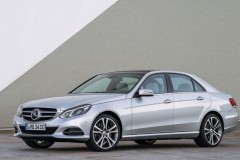
Mercedes E 200 2013 CDI Automatic technical data
| Model: | Mercedes E 200 2013 CDI Automatic |
|---|---|
| Body style: | Sedan |
| Production period: | 2013. January ... 2016. December |
| Engine: | 2143 cm3 Diesel, 4 cylinders |
| CO2 emissions: | 127 g/km |
| Power: | 136 HP ON 2800 RPM |
| Torque: | 360 NM ON 1600 RPM |
| Gearbox: | Automatic gearbox (7 gears) |
| Drive type: | Rear wheel drive (RWD) |
| Maximum speed: | 207 km/h |
| Acceleration 0-100 km/h: | 9.5 seconds |
| Fuel consumption (l/100km): | 4.9 (combined) 6.0 (urban) 4.2 (highway) |
| Real fuel consumption: | 6.9 l/100km (34.1 MPG) by user reviews from various sources |
| Fuel tank capacity: | 59 litres (15.6 gallons) |
| Car dimensions: | 4.88m (length) 1.85m (width) 1.47m (height) |
| Turning diameter: | 11.2 meters |
| Seats: | 4 seats |
| Gross weight: | 2300 kg Net weight: 1735 kg Load capacity: 565 kg |
Mercedes E 200 2013 CDI Automatic engine OM651 180/200 CDI red
Engine reliability and common problems:
The Mercedes-Benz OM651 is a 1.8–2.2-liter diesel engine used in models such as the 180 CDI and 200 CDI. It is known for good efficiency and strong durability, and well-maintained engines often exceed 400,000–500,000 km. The design includes a cast-iron cylinder block, an aluminum 16-valve cylinder head with hydraulic lifters, and a combined timing drive that uses a chain together with gears and balance shafts. Simpler versions use an IHI variable-geometry turbocharger, while more powerful variants are equipped with a BorgWarner twin-turbo system. Despite its good reputation, the engine also has several well-known weaknesses.One of the most serious problems involves bearing damage caused by overheating of the engine oil. If the oil cooler becomes clogged, the oil temperature rises and its lubricating properties deteriorate, which can lead to oil starvation and bearing failure. Because of this, the oil cooler is often recommended to be cleaned or replaced preventively around every 100,000 km.
The timing chain itself is usually quite durable and may last up to 300,000 km, but the hydraulic chain tensioner can wear out much earlier. When this happens the chain begins to rattle, and replacing the tensioner can require significant labor. The fuel system has also caused trouble, particularly in early engines. Versions produced before 2011 used Delphi piezo injectors that were prone to failure and in some cases caused severe engine damage. Later engines switched to electromagnetic injectors, which proved more reliable.
Another known weak point is the plastic intake manifold. After high mileage it can crack, allowing air leaks and triggering engine fault codes. Injectors may also seize in the cylinder head due to carbon buildup, which can make removal extremely difficult during repairs.
The cooling system includes a complex thermostat and pump arrangement with a vacuum actuator. When this mechanism fails, the engine may take too long to warm up or, in some cases, run hotter than intended. Additional issues occasionally reported include oil leaks, as well as clogging of the EGR system and diesel particulate filter.
Despite these shortcomings, the OM651 remains a capable and long-lasting diesel engine when maintained carefully. Regular oil changes with high-quality oil, monitoring the oil cooler condition, and proper servicing of the fuel system are essential for ensuring long-term reliability.
Overall, this engine can last around 250,000 to 420,000 km if properly maintained, using the correct quality oil and fuel, and carrying out regular checks and maintenance.
The engine has hydraulic valve tappets (lifters), which provide quieter operation and do not require periodic adjustment, but are more complex in design and can cause serious engine damage in the event of failure.
| Engine displacement | 2143 cm3 |
|---|---|
| Number of cylinders | 4 |
| Bore (cylinder diameter) | 83 mm |
| Stroke length (piston move) | 99 mm |
| Compression ratio | 16.2 : 1 |
| Camshaft drive | Timing chain Chain motors are considered more reliable, chain replacement usually is required less often than a timing belt, but they are often louder and vibrate more. More service info |
| Timing chain change interval | 250,000 km (recommended) Sometimes manufacturers do not specify timing chain replacement intervals and design chains for engine life. However, once the recommended change interval has been reached, it is recommended to periodically check the condition of the chain and to change the chain if excessive stretching is detected or if unusual noises from the engine or other symptoms occur. |
| Fuel system | Common Rail Common rail fuel injection provides more engine power, is quieter, more environmentally friendly and offers better fuel economy, but is more expensive to maintain and repair. |
| Mercedes E 200 2013 CDI Automatic oil type | 5W-30, 5W-40 |
| Oil capacity | 7.2 litres (7.6 quarts) More service info |
| Coolant capacity | 10 litres (10.6 quarts) |
| Power | 95 - 143 HP ON 2800 RPM |
| Torque | 250 - 360 NM ON 1600 RPM |
| Start of production (year) | 2010 |
| Duration of production | 16 years |
| Engine also used on | Mercedes C klase Mercedes A klase Mercedes B klase and 5 other models |
Generally, the use of an engine in several models and its long production run is an indication of the quality of the engine and the success of its design. |
Most often compared to
All Mercedes E class sedan [2013 - 2016] modifications
| Modification | Engine | Power | Consumption | Gearbox | Drive type |
|---|---|---|---|---|---|
| Mercedes E 200 2013 | 2.0 Petrol | 184 HP | 6.1 l/100km | Manual (6) | Rear wheel |
|
Mercedes E 200 2013 Automatic
Most fuel efficient petrol version |
2.0 Petrol | 184 HP | 5.8 l/100km | Automatic (7) | Rear wheel |
|
Mercedes E 250 2013
Most fuel efficient petrol version |
2.0 Petrol | 211 HP | 5.8 l/100km | Automatic (7) | Rear wheel |
|
Mercedes E 200 2013 CDI
Most fuel efficient diesel version by real consumption |
2.1 Diesel | 136 HP | 4.8 l/100km | Manual (6) | Rear wheel |
| Mercedes E 200 2013 CDI Automatic | 2.1 Diesel | 136 HP | 4.9 l/100km | Automatic (7) | Rear wheel |
|
Mercedes E 220 2013 CDI
Most fuel efficient diesel version |
2.1 Diesel | 170 HP | 4.7 l/100km | Manual (6) | Rear wheel |
|
Mercedes E 220 2013 CDI Automatic
Most fuel efficient diesel version |
2.1 Diesel | 170 HP | 4.7 l/100km | Automatic (7) | Rear wheel |
| Mercedes E 250 2013 CDI | 2.1 Diesel | 204 HP | 4.8 l/100km | Manual (6) | Rear wheel |
| Mercedes E 250 2013 CDI Automatic | 2.1 Diesel | 204 HP | 4.8 l/100km | Automatic (7) | Rear wheel |
| Mercedes E 250 2013 CDI 4Matic 4x4 | 2.1 Diesel | 204 HP | 5.5 l/100km | Automatic (7) | All wheel |
| Mercedes E 400 2013 4MATIC 4x4 | 3.0 Petrol | 333 HP | 8.5 l/100km | Automatic (7) | All wheel |
| Mercedes E 300 2013 BlueTEC | 3.0 Diesel | 231 HP | 5.5 l/100km | Automatic (7) | Rear wheel |
|
Mercedes E 350 2013 BlueTEC
Most powerfull diesel version (252 HP) |
3.0 Diesel | 252 HP | 5.5 l/100km | Automatic (7) | Rear wheel |
|
Mercedes E 350 2013 BlueTEC 4Matic 4x4
Most powerfull diesel version (252 HP) |
3.0 Diesel | 252 HP | 6.0 l/100km | Automatic (7) | All wheel |
| Mercedes E 300 2013 Jan 2013 — Dec 2014 | 3.5 Petrol | 252 HP | 6.8 l/100km | Automatic (7) | Rear wheel |
| Mercedes E 300 2013 4Matic 4x4 Jan 2013 — Dec 2014 | 3.5 Petrol | 252 HP | 7.4 l/100km | Automatic (7) | All wheel |
| Mercedes E 350 2013 Jan 2013 — Dec 2014 | 3.5 Petrol | 306 HP | 6.8 l/100km | Automatic (7) | Rear wheel |
| Mercedes E 350 2013 4Matic 4x4 Jan 2013 — Dec 2014 | 3.5 Petrol | 306 HP | 7.4 l/100km | Automatic (7) | All wheel |
| Mercedes E 500 2013 | 4.7 Petrol | 408 HP | 8.9 l/100km | Automatic (7) | Rear wheel |
| Mercedes E 500 2013 4Matic 4x4 | 4.7 Petrol | 408 HP | 9.4 l/100km | Automatic (7) | All wheel |
|
Mercedes E 63 2013 AMG
Jan 2013 — Dec 2015 Most powerfull petrol version (558 HP) |
5.5 Petrol | 558 HP | 9.8 l/100km | Automatic (7) | Rear wheel |
|
Mercedes E 63 2013 AMG 4Matic 4x4
Most dynamic version - 100 km/h in 3.7 seconds |
5.5 Petrol | 558 HP | 10.3 l/100km | Automatic (7) | All wheel |