
Mercedes S 350 2013 BlueTEC
Mercedes S class 2013 3.0 diesel description
Sedan Mercedes S 350 2013 BlueTEC has been produced from 2013 to 2017. It has six-cylinder diesel engine with displacement of 3.0 litres, which produces power of 258 horsepower at 3600 rpm and torque 620 Nm (Newton metres) on 2400 revolutions per minute.
This 6-cylinder 24-valve engine camshaft is driven by chain (What is an engine chain and belt? ). Engine has Common Rail fuel system, this is an atmospheric engine (without turbine). Engine versions compliant with Euro 5 and Euro 6 emission standards available. Engine lifespan (mileage before major repairs or overhaul) can last from 360 up to 600 thousand kilometres. Note that engine life can be longer or shorter depending on maintenance.
More engine specs
The Mercedes-Benz OM642 is a 3.0-liter V6 diesel widely used in many models under the 3.0 CDI or 350 CDI designation. It is known for strong performance and good durability when maintained properly, and well-kept engines are capable of exceeding 500,000 ...
This Mercedes S class 3.0 engine oil type is 5W-30, MB 228.51/229.51 and oil capacity is 8.8 litres.
Mercedes S 350 2013 BlueTEC has classical rear wheel drive (RWD) and automatic gearbox with 7 gears.
Mercedes S 350 2013 BlueTEC accelerates to speed 100 kilometres per hour in 6.8 seconds. The maximum speed of this car is 250 km/h.
Mercedes S 350 2013 BlueTEC fuel consumption is 5.9 litres per 100km in combined city/highway mode (16.9 km/l) - this is the most fuel efficient Mercedes S klase 2013 - 2017 version, fuel consumption in city - 7.3 l/100km, highway fuel economy - 5.1 l/100km. Fuel tank capacity is 70 litres or 18.49 gallons, which gives a mileage up to 1180 kilometers without refueling in urban cycle and even up to 1360 kilometers on highway.
According to user reviews, this Mercedes real everyday fuel consumption is 8.2 litres per 100 km, which is 39% more than the manufacturer's stated. More - Real Mercedes S class fuel consumption.
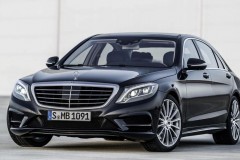
Mercedes S 350 2013 BlueTEC technical data
| Model: | Mercedes S 350 2013 BlueTEC |
|---|---|
| Body style: | Sedan |
| Production period: | 2013. January ... 2017. December |
| Engine: | 2987 cm3 Diesel, 6 cylinders |
| CO2 emissions: | no data |
| Power: | 258 HP ON 3600 RPM |
| Torque: | 620 NM ON 2400 RPM |
| Gearbox: | Automatic gearbox (7 gears) |
| Drive type: | Rear wheel drive (RWD) |
| Top speed: | 250 km/h |
| Acceleration 0-100 km/h: | 6.8 seconds |
| Fuel consumption (l/100km): | 5.9 (combined) 7.3 (urban) 5.1 (highway) |
| Real fuel consumption: | 8.2 l/100km (28.7 MPG) by user reviews from various sources |
| Fuel tank capacity: | 70 litres (18.5 gallons) |
| Car dimensions: | 5.12m (length) 1.90m (width) 1.50m (height) |
| Turning diameter: | 11.9 meters |
| Seats: | 5 seats |
| Gross weight: | 2655 kg Net weight: 1880 kg Load capacity: 775 kg |
Mercedes S 350 2013 BlueTEC engine OM642 350 CDI
Engine reliability and common problems:
The Mercedes-Benz OM642 is a 3.0-liter V6 diesel widely used in many models under the 3.0 CDI or 350 CDI designation. It is known for strong performance and good durability when maintained properly, and well-kept engines are capable of exceeding 500,000 km. At the same time, the unit has several characteristic weak points that tend to appear with age.One of the most well-known problems affects early engines produced before around 2010. The oil cooler sits deep in the valley of the V-engine, and the sealing gaskets eventually harden and begin to leak. When this happens, oil accumulates in the center of the engine block, and fixing the issue requires significant disassembly, making the repair relatively expensive.
The intake system can also cause trouble. The swirl flaps are operated by plastic linkages that may break over time, which leads to uneven engine operation, warning lights, and reduced power. The Bosch fuel system itself is generally efficient, but the piezo injectors are sensitive to fuel quality and are expensive to replace, often with little possibility of repair.
Turbocharger problems sometimes appear as mileage grows. Carbon deposits may cause the variable geometry mechanism to stick, and in some cases particles from a deteriorating exhaust manifold can damage the turbocharger. The engine is also quite sensitive to oil pressure. Issues with the oil pump, contaminated oil, or overheating can lead to bearing damage if lubrication becomes insufficient.
Additional concerns include the crankcase ventilation system, where the membrane inside the PCV valve may fail, as well as typical diesel emissions components such as the EGR valve and diesel particulate filter, which can become clogged over time.
Despite these weaknesses, the OM642 remains a respected engine when serviced correctly. It delivers strong performance, uses a durable double-row timing chain, and the cylinder heads are equipped with hydraulic lifters that reduce maintenance needs. With regular oil changes—preferably every 10,000 km or sooner—and good-quality fuel, it can be a long-lasting and capable diesel engine.
Overall, this engine can last around 360,000 to 600,000 km if properly maintained, using the correct quality oil and fuel, and carrying out regular checks and maintenance.
The engine has hydraulic valve tappets (lifters), which provide quieter operation and do not require periodic adjustment, but are more complex in design and can cause serious engine damage in the event of failure.
| Engine displacement | 2987 cm3 |
|---|---|
| Number of cylinders | 6 |
| Bore (cylinder diameter) | 83 mm |
| Stroke length (piston move) | 92 mm |
| Compression ratio | 18 : 1 |
| Camshaft drive | Timing chain Chain motors are considered more reliable, chain replacement usually is required less often than a timing belt, but they are often louder and vibrate more. More service info |
| Timing chain change interval | 400,000 km (recommended) Sometimes manufacturers do not specify timing chain replacement intervals and design chains for engine life. However, once the recommended change interval has been reached, it is recommended to periodically check the condition of the chain and to change the chain if excessive stretching is detected or if unusual noises from the engine or other symptoms occur. |
| Fuel system | Common Rail Common rail fuel injection provides more engine power, is quieter, more environmentally friendly and offers better fuel economy, but is more expensive to maintain and repair. |
| Mercedes S 350 2013 BlueTEC oil type | 5W-30, MB 228.51/229.51 |
| Oil capacity | 8.8 litres (9.3 quarts) More service info |
| Coolant capacity | 11.6 litres (12.3 quarts) |
| Power | 231 - 265 HP ON 3600 RPM |
| Torque | 540 - 620 NM ON 2400 RPM |
| Start of production (year) | 2005 |
| Duration of production | 21 years |
| Engine also used on | Mercedes C klase Mercedes E klase Mercedes ML and 6 other models |
Generally, the use of an engine in several models and its long production run is an indication of the quality of the engine and the success of its design. |
All Mercedes S class sedan [2013 - 2017] modifications
| Modification | Engine | Power | Consumption | Drive type |
|---|---|---|---|---|
|
Mercedes S 350 2013 BlueTEC
Most fuel efficient diesel version |
3.0 Diesel | 258 HP | 5.9 l/100km | Rear wheel |
| Mercedes S 350 2013 BlueTEC Lang | 3.0 Diesel | 258 HP | 6.0 l/100km | Rear wheel |
| Mercedes S 400 2013 HYBRID | 3.5 Hybrid HEV |
333 HP | 6.8 l/100km | Rear wheel |
|
Mercedes S 500 2013
Most fuel efficient petrol version |
4.7 Petrol | 456 HP | 9.1 l/100km | Rear wheel |
|
Mercedes S 500 2013 Lang
Most fuel efficient petrol version |
4.7 Petrol | 456 HP | 9.1 l/100km | Rear wheel |
|
Mercedes S 63 2013 AMG
Most dynamic version - 100 km/h in 4 seconds |
5.5 Petrol | 585 HP | 10.1 l/100km | Rear wheel |
|
Mercedes S 63 2013 AMG 4MATIC 4x4
Most dynamic version - 100 km/h in 4 seconds |
5.5 Petrol | 585 HP | 10.3 l/100km | All wheel |