
Audi A5 2016 Sportback 2.0 TDI
Audi A5 2016 2.0 diesel description
Hatchback Audi A5 2016 Sportback 2.0 TDI has been produced from 2016 to 2018. It has four-cylinder diesel engine with displacement of 2.0 litres, which produces power of 190 horsepower at 4200 rpm and torque 400 Nm (Newton metres) on 1750 revolutions per minute.
This 4-cylinder 16-valve engine camshaft is driven by belt (What is an engine chain and belt? ). Engine has Common Rail fuel system and BorgWarner BV43D turbine. Engine versions compliant with Euro 5 and Euro 6 emission standards available. Engine lifespan (mileage before major repairs or overhaul) can last from 270 up to 450 thousand kilometres. Note that engine life can be longer or shorter depending on maintenance.
More engine specs
The Audi 2.0 TDI from the EA288 family (engine code DETA, 190 hp) is a modern diesel designed to combine good performance with efficiency. In general it has a solid reputation and, when properly maintained, can ...
This Audi A5 2.0 engine oil type is 5W-30 and oil capacity is 4.7 litres.
Audi A5 2016 Sportback 2.0 TDI has front wheel drive (FWD) and manual gearbox with 6 gears.
Audi A5 2016 Sportback 2.0 TDI accelerates to speed 100 kilometres per hour in 7.9 seconds. The maximum speed of this car is 235 km/h.
Audi A5 2016 Sportback 2.0 TDI fuel consumption is 4.6 litres per 100km in combined city/highway mode (21.7 km/l) - this is one of most fuel efficient Audi A5 2016 - 2019 versions, city fuel economy - 5.4 l/100km, fuel consumption on highway - 4.1 l/100km. Fuel tank capacity is 40 litres or 10.57 gallons, which gives a mileage up to 860 kilometers without refueling in urban cycle and even up to 960 kilometers on highway.
According to user reviews, this Audi real everyday fuel consumption is 6.6 litres per 100 km, which is 43% more than the manufacturer's stated. More - Real Audi A5 fuel consumption.
- Audi A5 2016 Sportback 2.0 TDI AT manufacturer's fuel consumption is lower by 0.2 litres per 100 km or 4 % - 4.4 litres per 100 km, whereas users reported real fuel consumption is lower by 0.2 litres per 100 km or 3 % - 6.4 litres per 100 km
- Audi A5 2016 Sportback 2.0 TDI Quattro AT 4x4 is more dynamic - it reaches 100 km/h 0.5 seconds faster (in 7.4 seconds), but manufacturer's fuel consumption is similar - 4.7 litres per 100 km, whereas users reported real fuel consumption is lower by 0.2 litres per 100 km or 3 % - 6.4 litres per 100 km
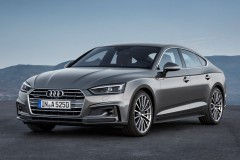
Audi A5 2016 Sportback 2.0 TDI technical data
| Model: | Audi A5 Sportback 2.0 TDI |
|---|---|
| Body style: | Hatchback |
| Production period: | 2016. January ... 2018. December |
| Engine: | 1968 cm3 Diesel, 4 cylinders |
| CO2 emissions: | no data |
| Power: | 190 HP ON 4200 RPM |
| Torque: | 400 NM ON 1750 RPM |
| Gearbox: | Manual gearbox (6 gears) |
| Drive type: | Front wheel drive (FWD) |
| Top speed: | 235 km/h |
| Acceleration 0-100 km/h: | 7.9 seconds |
| Fuel consumption (l/100km): | 4.6 (combined) 5.4 (urban) 4.1 (highway) |
| Real fuel consumption: | 6.6 l/100km (35.6 MPG) by user reviews from various sources |
| Fuel tank capacity: | 40 litres (10.6 gallons) |
| Car dimensions: | 4.73m (length) 1.84m (width) 1.39m (height) |
| Turning diameter: | 11.7 meters |
| Seats: | 5 seats |
| Gross weight: | 2095 kg Net weight: 1500 kg Load capacity: 595 kg |
Audi A5 2016 Sportback 2.0 TDI engine DETA
Engine reliability and common problems:
The Audi 2.0 TDI from the EA288 family (engine code DETA, 190 hp) is a modern diesel designed to combine good performance with efficiency. In general it has a solid reputation and, when properly maintained, can exceed 300,000 km. Nevertheless, like most contemporary diesel engines, it has several components that tend to require attention over time.One of the weaker points is the dual-mass flywheel. In some cases it begins to wear out relatively early, sometimes before 100,000 km, which leads to noticeable vibrations and noise. Another common issue involves the EGR system. Carbon deposits accumulate quickly in the valve and intake passages, especially in vehicles used mainly for city driving, which can cause warning lights, reduced performance, and the need for periodic cleaning or replacement.
The fuel system is also quite sensitive to diesel quality. Using low-grade fuel can significantly shorten the lifespan of the injectors and other fuel components, often resulting in expensive repairs. The water pump is another part that may fail earlier than expected, sometimes before the scheduled replacement of the timing belt.
Like many modern diesels equipped with a particulate filter, this engine requires the correct low-ash oil specification. Using oil that does not meet VW 507.00 or 509.00 standards can shorten the life of the DPF and lead to additional maintenance costs. Increased oil consumption is not common but may appear at higher mileage or in engines that have not been serviced regularly.
Despite these weaknesses, the DETA remains a capable and generally reliable diesel engine when maintained carefully. Regular oil changes with the proper specification, good-quality fuel, and attention to emissions components are essential for long-term durability.
Overall, this engine can last around 270,000 to 450,000 km if properly maintained, using the correct quality oil and fuel, and carrying out regular checks and maintenance.
The engine has hydraulic valve tappets (lifters), which provide quieter operation and do not require periodic adjustment, but are more complex in design and can cause serious engine damage in the event of failure.
| Engine displacement | 1968 cm3 |
|---|---|
| Number of cylinders | 4 |
| Bore (cylinder diameter) | 81 mm |
| Stroke length (piston move) | 95.5 mm |
| Compression ratio | 15.5 : 1 |
| Camshaft drive | Timing belt Timing belt engines are generally quieter and less vibrating than chain engines, but belt usually needs to be replaced more often and the risk of breakage is higher. More service info |
| Timing belt change interval | 90,000 km |
| Fuel system | Common Rail Common rail fuel injection provides more engine power, is quieter, more environmentally friendly and offers better fuel economy, but is more expensive to maintain and repair. |
| Audi A5 2016 Sportback 2.0 TDI oil type | 5W-30 |
| Oil capacity | 4.7 litres (5 quarts) More service info |
| Power | 190 HP ON 4200 RPM |
| Torque | 400 NM ON 1750 RPM |
| Start of production (year) | 2015 |
| Duration of production | 11 years |
| Engine also used on | Audi A4 Audi A6 Audi Q5 Audi Q3 |
Generally, the use of an engine in several models and its long production run is an indication of the quality of the engine and the success of its design. |
Most often compared to
All Audi A5 hatchback [2016 - 2019] modifications
| Modification | Engine | Power | Consumption | Gearbox | Drive type |
|---|---|---|---|---|---|
|
Audi A5 2016 Sportback 2.0 TFSI
Most fuel efficient petrol version |
2.0 Petrol | 252 HP | 5.1 l/100km | Automatic (7) | Front wheel |
|
Audi A5 2016 Sportback 2.0 TFSI Quattro 4x4
Most dynamic version - 100 km/h in 6 seconds |
2.0 Petrol | 252 HP | 5.4 l/100km | Automatic (7) | All wheel |
|
Audi A5 2016 Sportback 2.0 TDI
Jan 2016 — Dec 2018 Only version with manual transmission |
2.0 Diesel | 190 HP | 4.6 l/100km | Manual (6) | Front wheel |
|
Audi A5 2016 Sportback 2.0 TDI
Most fuel efficient diesel version |
2.0 Diesel | 190 HP | 4.4 l/100km | Automatic (7) | Front wheel |
|
Audi A5 2016 Sportback 2.0 TDI Quattro 4x4
Most fuel efficient diesel version by real consumption |
2.0 Diesel | 190 HP | 4.7 l/100km | Automatic (7) | All wheel |
|
Audi A5 2016 Sportback 3.0 TDI Quattro 4x4
Jan 2016 — Dec 2018 Most powerfull diesel version (218 HP) |
3.0 Diesel | 218 HP | 4.8 l/100km | Automatic (7) | All wheel |