
BMW 540i (G30)
BMW 5 series 2020 3.0 petrol description
Sedan BMW 540i has been produced from 2020 to 2023. It has six-cylinder petrol engine with displacement of 3.0 litres, which produces power of 333 horsepower on 5500 rpm and torque 450 Nm (Newton metres) on 1600 revolutions per minute. It is an MHEV (Mild Hybrid) hybrid vehicle, with electric motor that assists the internal combustion engine, however, the car cannot run on electric power alone, and the battery is charged while driving (external charging is not available).
This 6-cylinder 24-valve engine camshaft is driven by chain (What is an engine chain and belt? ). Engine has fuel injection system and Twin-Scroll turbine. The engine meets the Euro 6 emissions standard. Engine lifespan (mileage before major repairs or overhaul) can last from 210 up to 360 thousand kilometres. It is important to remember that engine life is highly dependent on regular maintenance and the quality of the oils and fuels used.
More engine specs
The B58 engine, compared to its predecessor, features a 20% increase in boost pressure, a closed-deck cylinder block design, an increased compression ratio of 11.0:1, and a slightly larger displacement of 2998 cc, up from 2979 cc, with an additional weight of 8 ...
This BMW 5 series 3.0 engine oil type is 0W-20, 0W-30, 5W-30 and oil capacity is 6.5 litres.
BMW 540i has classical rear wheel drive (RWD) and automatic gearbox with 8 gears.
BMW 540i accelerates to speed 100 kilometres per hour in 5.2 seconds. The maximum speed of this car is 250 km/h.
BMW 540i fuel consumption is 6.5 litres per 100km in combined city/highway mode (15.4 km/l), fuel consumption in city - 8.5 l/100km, highway fuel economy - 5.4 l/100km. Fuel tank capacity is 68 litres or 17.97 gallons, which gives a mileage up to 1040 kilometers without refueling in urban cycle and even up to 1240 kilometers on highway.
According to user reviews, this BMW real everyday fuel consumption is 9.3 litres per 100 km, which is 43% more than the manufacturer's stated. More - Real BMW 5 series fuel consumption.
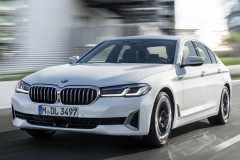
BMW 540i technical data
| Model: | BMW 540i | ||
|---|---|---|---|
| Body style: | Sedan | ||
| Production period: | 2020. January ... 2023. December | ||
| Engine: | 2998 cm3 Petrol, 6 cylinders | CO2 emissions: | no data |
| Power: | 333 HP ON 5500 RPM | Torque: | 450 NM ON 1600 RPM |
| Gearbox: | Automatic gearbox (8 gears) | Drive type: | Rear wheel drive (RWD) |
| Top speed: | 250 km/h | Acceleration 0-100 km/h: | 5.2 seconds |
| Fuel consumption (l/100km): | 6.5 (combined) 8.5 (urban) 5.4 (highway) | ||
| Battery capacity: | 0.528 kWh (total) | ||
| Real fuel consumption: | 9.3 l/100km (25.3 MPG) by user reviews from various sources | ||
| Fuel tank capacity: | 68 litres (18 gallons) | ||
| Car dimensions: | 4.96m (length) 1.87m (width) 1.48m (height) | ||
| Turning diameter: | 12 meters | ||
| Ground clearance: | 144 mm (approximate, with standard suspension, unladen vehicle) | ||
| Seats: | 5 seats | ||
| Gross weight: | 2395 kg Net weight: 1685 kg Load capacity: 710 kg | ||
BMW 540i engine B58B30M1
Engine reliability and common problems:
The B58 engine, compared to its predecessor, features a 20% increase in boost pressure, a closed-deck cylinder block design, an increased compression ratio of 11.0:1, and a slightly larger displacement of 2998 cc, up from 2979 cc, with an additional weight of 8 kg. Despite its advancements, the engine has several common issues.Coolant leaks are frequently reported, often linked to a drop in coolant levels without an obvious cause. In some cases, replacing the expansion tank cap resolves the issue. Head gasket failure is another recurring problem due to the engine's high operating temperatures. Symptoms include a strong smell of burning oil and sometimes visible smoke. Oil leaks are also common, originating from areas such as the oil filter housing, oil cooler, or head gasket. Prompt repairs are crucial to prevent oil starvation and potential engine damage.
The B58, like many direct-injection engines, often experiences carbon buildup on intake valves, leading to fluctuating idle and reduced performance. Less frequently, issues arise with the VANOS system, responsible for variable valve timing. Symptoms include power loss, uneven idle, stalling, and high fuel consumption. VANOS problems typically appear around 80,000–100,000 km. Oil filter disintegration is another concern, with parts of the filter sometimes breaking off and getting stuck in the housing. This can lead to oil leaks and other complications, often caused by low-quality filters or improper replacement.
Additionally, valve cover gaskets are prone to leaks, with symptoms such as the smell of burning oil, smoke, or low oil level warnings. Plastic valve covers can also crack over time. These issues usually arise between 60,000 and 100,000 km. Some BMW G-series models produced before 2021 may encounter failures in the oil pump due to a design flaw in the internal bushing. The recommended solution is upgrading to the sixth revision oil pump with a metal component.
Overall, while the B58 engine is a significant improvement in performance and efficiency, these known issues highlight the importance of regular maintenance, timely repairs, and the use of high-quality parts to ensure reliability.
Overall, this engine can last around 210,000 to 360,000 km if properly maintained, using the correct quality oil and fuel, and carrying out regular checks and maintenance.
The engine has hydraulic valve tappets (lifters), which provide quieter operation and do not require periodic adjustment, but are more complex in design and can cause serious engine damage in the event of failure.
| Engine displacement | 2998 cm3 |
|---|---|
| Number of cylinders | 6 |
| Bore (cylinder diameter) | 82 mm |
| Stroke length (piston move) | 94.6 mm |
| Compression ratio | 11 : 1 |
| Camshaft drive | Timing chain Chain motors are considered more reliable, chain replacement usually is required less often than a timing belt, but they are often louder and vibrate more. |
| Fuel system | Injection |
| BMW 540i oil type | 0W-20, 0W-30, 5W-30 |
| Oil capacity | 6.5 litres (6.9 quarts) |
| Coolant capacity | 8 litres (8.5 quarts) |
| Power | 333 - 340 HP ON 5500 RPM |
| Torque | 450 - 500 NM ON 1600 RPM |
| Start of production (year) | 2018 |
| Duration of production | 8 years |
Often in the first years of production, engines tend to have various constructive problems, so it is recommended to choose a car with this engine from 2021 onwards. |
|
| Engine also used on | BMW 7 sērija BMW 6 sērija BMW 8 sērija |
Generally, the use of an engine in several models and its long production run is an indication of the quality of the engine and the success of its design. |
All BMW 5 series sedan [2020 - 2023] modifications
| Modification | Engine | Power | Consumption | Drive type |
|---|---|---|---|---|
| BMW 520i | 1.6 Petrol | 170 HP | 7.8 l/100km | Rear wheel |
|
BMW 520i
Most fuel efficient petrol version by real consumption |
2.0 Petrol MHEV hybrid engine |
184 HP | 6.8 l/100km | Rear wheel |
| BMW 530i xDrive 4x4 Jan 2020 — Dec 2022 | 2.0 Petrol MHEV hybrid engine |
249 HP | 7.3 l/100km | All wheel |
|
BMW 530i
Jan 2020 — Dec 2022 Most fuel efficient petrol version |
2.0 Petrol MHEV hybrid engine |
252 HP | 5.5 l/100km | Rear wheel |
|
BMW 520d
Most fuel efficient diesel version by real consumption |
2.0 Diesel MHEV hybrid engine |
190 HP | 5.2 l/100km | Rear wheel |
|
BMW 520d xDrive 4x4
Most fuel efficient diesel version by real consumption |
2.0 Diesel MHEV hybrid engine |
190 HP | 5.3 l/100km | All wheel |
| BMW 520e Jan 2020 — Dec 2022 | 2.0 Hybrid PHEV |
163 HP | 1.8 l/100km | Rear wheel |
| BMW 530e | 2.0 Hybrid PHEV |
184 HP | 1.8 l/100km | Rear wheel |
| BMW 530e 4x4 | 2.0 Hybrid PHEV |
184 HP | 2.1 l/100km | All wheel |
| BMW 540i | 3.0 Petrol MHEV hybrid engine |
333 HP | 6.5 l/100km | Rear wheel |
| BMW 540i xDrive 4x4 | 3.0 Petrol MHEV hybrid engine |
340 HP | 7.9 l/100km | All wheel |
| BMW 530d xDrive 4x4 | 3.0 Diesel | 249 HP | 5.9 l/100km | All wheel |
|
BMW 530d
Most fuel efficient diesel version |
3.0 Diesel MHEV hybrid engine |
286 HP | 4.6 l/100km | Rear wheel |
| BMW 530d 4x4 | 3.0 Diesel MHEV hybrid engine |
286 HP | 5.0 l/100km | All wheel |
|
BMW 540d 4x4
Most powerfull diesel version (340 HP) |
3.0 Diesel MHEV hybrid engine |
340 HP | 5.1 l/100km | All wheel |
| BMW 545e 4x4 | 3.0 Hybrid PHEV |
286 HP | 2.3 l/100km | All wheel |
|
BMW M550i xDrive 4x4
Most dynamic version - 100 km/h in 3.8 seconds |
4.4 Petrol | 530 HP | 10.7 l/100km | All wheel |