
Ford Focus 2005 1.8 16V
Ford Focus 2005 1.8 petrol description
Sedan Ford Focus 2005 1.8 16V has been produced from 2005 to 2008. It has four-cylinder petrol engine with displacement of 1.8 litres, which produces power of 125 horsepower at 6000 rpm and torque 170 Nm (Newton metres) on 4500 revolutions per minute.
This 4-cylinder 16-valve engine camshaft is driven by chain (What is an engine chain and belt? ). Engine has fuel injection system, this is an atmospheric engine (without turbine). The engine meets the Euro 4 emissions standard. Engine lifespan (mileage before major repairs or overhaul) can last from 320 up to 540 thousand kilometres. Remember that engine life depends on regular maintenance and the quality of the materials used (oils, fuels, etc.).
More engine specs
The Ford CHBA/CHBB, also known as the 1.8 Duratec HE, is a naturally aspirated four-cylinder gasoline engine introduced in 2000 and developed with Mazda’s involvement. It uses an aluminum cylinder block and aluminum 16-valve cylinder head with two ...
This Ford Focus 1.8 engine oil type is 5W-30 and oil capacity is 4.3 litres.
Ford Focus 2005 1.8 16V has front wheel drive (FWD) and manual gearbox with 5 gears.
Ford Focus 2005 1.8 16V accelerates to speed 100 kilometres per hour in 10.3 seconds. The maximum speed of this car is 198 km/h.
Ford Focus 2005 1.8 16V fuel consumption is 7.1 litres per 100km in combined city/highway mode (14.1 km/l), fuel consumption in city - 9.6 l/100km, highway fuel economy - 5.6 l/100km. Fuel tank capacity is 55 litres or 14.53 gallons, which gives a mileage up to 760 kilometers without refueling in urban cycle and even up to 980 kilometers on highway.
According to user reviews, this Ford real everyday fuel consumption is 8.2 litres per 100 km, which is 15% more than the manufacturer's stated. More - Real Ford Focus fuel consumption.
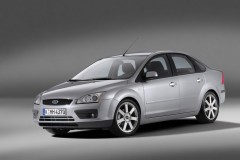
Ford Focus 2005 1.8 16V technical data
| Model: | Ford Focus 1.8 16V |
|---|---|
| Body style: | Sedan |
| Production period: | 2005. January ... 2008. January |
| Engine: | 1798 cm3 Petrol, 4 cylinders |
| CO2 emissions: | no data |
| Power: | 125 HP ON 6000 RPM |
| Torque: | 170 NM ON 4500 RPM |
| Gearbox: | Manual gearbox (5 gears) |
| Drive type: | Front wheel drive (FWD) |
| Top speed: | 198 km/h |
| Acceleration 0-100 km/h: | 10.3 seconds |
| Fuel consumption (l/100km): | 7.1 (combined) 9.6 (urban) 5.6 (highway) |
| Real fuel consumption: | 8.2 l/100km (28.7 MPG) by user reviews from various sources |
| Fuel tank capacity: | 55 litres (14.5 gallons) |
| Car dimensions: | 4.49m (length) 1.84m (width) 1.50m (height) |
| Turning diameter: | 10.4 meters |
| Seats: | 5 seats |
| Trunk capacity: | 467 litres |
| Trunk max capacity: | 872 litres (with rear seats folded down, if possible) |
| Gross weight: | 1810 kg Net weight: 1295 kg Load capacity: 515 kg |
Ford Focus 2005 1.8 16V engine CHBB, Duratec HE (CHBA)
Engine reliability and common problems:
The Ford CHBA/CHBB, also known as the 1.8 Duratec HE, is a naturally aspirated four-cylinder gasoline engine introduced in 2000 and developed with Mazda’s involvement. It uses an aluminum cylinder block and aluminum 16-valve cylinder head with two camshafts, multipoint fuel injection, and a timing chain drive. With around 125 hp and 170 Nm, it was never meant to be a performance engine, but it offered good fuel economy and proved especially suitable for everyday use.Overall, this engine has a strong reputation for durability. The manufacturer’s claimed service life is around 350,000 km, but in practice well-maintained examples can go beyond 400,000 km. Its simple construction helps here: there is no turbocharger, no hydraulic lifters, and in many versions no complicated variable valve timing system. At the same time, this simplicity also brings some maintenance requirements.
One important point is valve clearance adjustment. Since the engine has no hydraulic lifters, valve clearances need to be checked and adjusted periodically, usually around every 100,000 km. This is not the cheapest service, but ignoring it can affect engine operation over time.
The most common complaint is increased oil consumption. It is usually caused by oil control rings that become stuck with carbon deposits, especially on higher-mileage engines or engines with poor oil service history. Another well-known issue is sticking intake manifold flaps, which can cause unstable operation and require cleaning or repair.
Fuel quality also matters. Poor gasoline can shorten the life of the fuel pump and fuel pressure regulator, so using decent fuel is important for avoiding unnecessary repairs. The timing chain is generally durable, but after roughly 200,000 km it may stretch and require replacement. If ignored, chain wear can lead to more serious timing-related damage.
Despite these weaknesses, the CHBA/CHBB remains a reliable and practical engine. It is not particularly powerful, but it is simple, economical, and capable of very high mileage when serviced regularly with good oil, proper fuel, and timely valve adjustment.
Overall, this engine can last around 320,000 to 540,000 km if properly maintained, using the correct quality oil and fuel, and carrying out regular checks and maintenance.
| Engine displacement | 1798 cm3 |
|---|---|
| Number of cylinders | 4 |
| Bore (cylinder diameter) | 83 mm |
| Stroke length (piston move) | 83.1 mm |
| Compression ratio | 10.8 : 1 |
| Camshaft drive | Timing chain Chain motors are considered more reliable, chain replacement usually is required less often than a timing belt, but they are often louder and vibrate more. More service info |
| Timing chain change interval | 200,000 km (recommended) Sometimes manufacturers do not specify timing chain replacement intervals and design chains for engine life. However, once the recommended change interval has been reached, it is recommended to periodically check the condition of the chain and to change the chain if excessive stretching is detected or if unusual noises from the engine or other symptoms occur. |
| Fuel system | Injection |
| Ford Focus 2005 1.8 16V oil type | 5W-30 |
| Oil capacity | 4.3 litres (4.5 quarts) More service info |
| Coolant capacity | 6.5 litres (6.9 quarts) |
| Power | 125 HP ON 6000 RPM |
| Torque | 170 NM ON 4500 RPM |
| Start of production (year) | 2000 |
| Duration of production | 7 years |
| Engine also used on | Ford Mondeo |
All Ford Focus sedan [2005 - 2008] modifications
| Modification | Engine | Power | Consumption | Gearbox |
|---|---|---|---|---|
|
Ford Focus 2005 1.4 16V
Mai 2005 — Jan 2008 Most fuel efficient petrol version by real consumption |
1.4 Petrol | 80 HP | 6.6 l/100km | Manual (5) |
| Ford Focus 2005 1.6 16V Mai 2005 — Jan 2008 | 1.6 Petrol | 100 HP | 6.7 l/100km | Manual (5) |
| Ford Focus 2005 1.6 16V Mai 2005 — Jan 2008 | 1.6 Petrol | 100 HP | 7.7 l/100km | Automatic (4) |
|
Ford Focus 2005 1.6 16V Ti-VCT
Mai 2005 — Jan 2008 Most fuel efficient petrol version |
1.6 Petrol | 115 HP | 6.4 l/100km | Manual (5) |
|
Ford Focus 2005 1.6 TDCi
Mai 2005 — Jan 2008 Most fuel efficient diesel version |
1.6 Diesel | 90 HP | 4.7 l/100km | Manual (5) |
| Ford Focus 2005 1.6 TDCi Mai 2005 — Jan 2008 | 1.6 Diesel | 109 HP | 4.8 l/100km | Manual (5) |
| Ford Focus 2005 1.6 TDCi Oct 2005 — Jan 2008 | 1.6 Diesel | 109 HP | - | Automatic |
| Ford Focus 2005 1.8 16V | 1.8 Petrol | 125 HP | 7.1 l/100km | Manual (5) |
| Ford Focus 2005 1.8 TDCi Mai 2005 — Jan 2008 | 1.8 Diesel | 115 HP | 5.3 l/100km | Manual (5) |
|
Ford Focus 2005 2.0 16V
Mai 2005 — Jan 2008 Most dynamic version - 100 km/h in 9.3 seconds |
2.0 Petrol | 145 HP | 7.1 l/100km | Manual (5) |
|
Ford Focus 2005 2.0 16V
Oct 2005 — Jan 2008 Most powerfull petrol version (145 HP) |
2.0 Petrol | 145 HP | 8.0 l/100km | Automatic (4) |
|
Ford Focus 2005 2.0 TDCi
Mai 2005 — Jan 2008 Most powerfull diesel version (136 HP) |
2.0 Diesel | 136 HP | 5.6 l/100km | Manual (6) |