
BMW 530i (G31)
BMW 5 series 2020 2.0 petrol description
Estate car / wagon BMW 530i has been produced from 2020 to 2022. It has four-cylinder petrol engine with displacement of 2.0 litres, which produces power of 252 horsepower on 5200 rpm and torque 350 Nm (Newton metres) on 1450 revolutions per minute. It is an MHEV (Mild Hybrid) hybrid vehicle, with electric motor that assists the internal combustion engine, however, the car cannot run on electric power alone, and the battery is charged while driving (external charging is not available).
This 4-cylinder 16-valve engine camshaft is driven by chain (What is an engine chain and belt? ). Engine has fuel injection system and MHI TD04LR6W turbine. The engine meets the Euro 6 emissions standard. Approximate engine life expectancy (mileage until serious repairs are required) for this engine is between 200 000 and 340 000 kilometres. Remember that engine life depends on regular maintenance and the quality of the materials used (oils, fuels, etc.).
More engine specs
Compared to their predecessors, B48 engines are more robust and less prone to major failures. They are well-suited for chip tuning, which can noticeably enhance ...
This BMW 5 series 2.0 engine oil type is 0W-30, 5W-30, 0W-20 and oil capacity is 5.3 litres.
BMW 530i has all four wheel drive (AWD, 4x4) and automatic gearbox with 8 gears.
BMW 530i accelerates to speed 100 kilometres per hour in 6.6 seconds. The maximum speed of this car is 250 km/h.
In combined cycle (city and motorway), the BMW 530i fuel consumption is 6.4 litres per 100km (15.6 km/l), fuel consumption in city - 7.9 l/100km, highway fuel economy - 5.6 l/100km. Fuel tank capacity is 68 litres or 17.97 gallons, which gives a mileage up to 1060 kilometers without refueling in urban cycle and even up to 1200 kilometers on highway.
According to user reviews, this BMW real everyday fuel consumption is 8.5 litres per 100 km, which is 33% more than the manufacturer's stated. More - Real BMW 5 series fuel consumption.
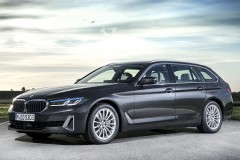
BMW 530i technical data
| Model: | BMW 530i | ||
|---|---|---|---|
| Body style: | Estate car / wagon | ||
| Production period: | 2020. January ... 2022. December | ||
| Engine: | 1998 cm3 Petrol, 4 cylinders | CO2 emissions: | no data |
| Power: | 252 HP ON 5200 RPM | Torque: | 350 NM ON 1450 RPM |
| Gearbox: | Automatic gearbox (8 gears) | Drive type: | All wheel drive (AWD, 4x4) |
| Top speed: | 250 km/h | Acceleration 0-100 km/h: | 6.6 seconds |
| Fuel consumption (l/100km): | 6.4 (combined) 7.9 (urban) 5.6 (highway) | ||
| Battery capacity: | 0.528 kWh (total) | ||
| Real fuel consumption: | 8.5 l/100km (27.7 MPG) by user reviews from various sources | ||
| Fuel tank capacity: | 68 litres (18 gallons) | ||
| Car dimensions: | 4.96m (length) 1.87m (width) 1.50m (height) | ||
| Turning diameter: | 12.4 meters | ||
| Ground clearance: | 140 mm (approximate, with standard suspension, unladen vehicle) | ||
| Seats: | 5 seats | ||
| Trunk capacity: | 560 litres | ||
| Trunk max capacity: | 1700 litres (with rear seats folded down, if possible) | ||
| Gross weight: | 2490 kg Net weight: 1790 kg Load capacity: 700 kg | ||
BMW 530i engine B48B20O0
Engine reliability and common problems:
Compared to their predecessors, B48 engines are more robust and less prone to major failures. They are well-suited for chip tuning, which can noticeably enhance performance and responsiveness without compromising reliability.Oil consumption, while significantly improved over earlier engines, may still appear closer to 100,000 km, often due to hardened valve stem seals. Another common issue is unstable idle or fault codes related to a lean mixture, typically caused by a faulty fuel tank ventilation valve — a relatively inexpensive part.
The cooling system is a known weak point. Coolant leaks may result from seal failures, cracks, thermostat or pump malfunctions, or general contamination. Symptoms include engine overheating, white smoke from the exhaust, poor coolant quality, visible leaks, warnings on the dashboard, and elevated temperature readings.
These engines are sensitive to fuel quality and oil change intervals. Cutting corners on maintenance often leads to costly repairs or even engine replacement.
At higher mileage, weaknesses may also include chain tensioners, the VANOS and Valvetronic systems, high-pressure fuel pumps, throttle actuators, and the turbocharger.
Overall, the B48 is a reliable and practical engine without inherent flaws. The mentioned issues tend to appear only under certain conditions and are not universal across all units.
Overall, this engine can last around 200,000 to 340,000 km if properly maintained, using the correct quality oil and fuel, and carrying out regular checks and maintenance.
The engine has hydraulic valve tappets (lifters), which provide quieter operation and do not require periodic adjustment, but are more complex in design and can cause serious engine damage in the event of failure.
| Engine displacement | 1998 cm3 |
|---|---|
| Number of cylinders | 4 |
| Bore (cylinder diameter) | 82 mm |
| Stroke length (piston move) | 94.6 mm |
| Compression ratio | 10.2 : 1 |
| Camshaft drive | Timing chain Chain motors are considered more reliable, chain replacement usually is required less often than a timing belt, but they are often louder and vibrate more. More service info |
| Fuel system | Injection |
| BMW 530i oil type | 0W-30, 5W-30, 0W-20 |
| Oil capacity | 5.3 litres (5.6 quarts) More service info |
| Coolant capacity | 9.9 litres (10.5 quarts) |
| Power | 252 HP ON 5200 RPM |
| Torque | 350 NM ON 1450 RPM |
| Start of production (year) | 2014 |
| Duration of production | 12 years |
| Engine also used on | BMW 3 sērija BMW 1 sērija BMW X3 BMW 4 sērija and 3 other models |
Generally, the use of an engine in several models and its long production run is an indication of the quality of the engine and the success of its design. |
All BMW 5 series estate car [2020 - 2024] modifications
| Modification | Engine | Power | Consumption | Drive type |
|---|---|---|---|---|
|
BMW 520i
Most fuel efficient petrol version |
2.0 Petrol MHEV hybrid engine |
184 HP | 5.7 l/100km | Rear wheel |
| BMW 530i Jan 2020 — Dec 2022 | 2.0 Petrol MHEV hybrid engine |
252 HP | 5.8 l/100km | Rear wheel |
| BMW 530i 4x4 Jan 2020 — Dec 2022 | 2.0 Petrol MHEV hybrid engine |
252 HP | 6.4 l/100km | All wheel |
|
BMW 520d
Most fuel efficient diesel version |
2.0 Diesel MHEV hybrid engine |
190 HP | 4.5 l/100km | Rear wheel |
|
BMW 520d 4x4
Most fuel efficient diesel version by real consumption |
2.0 Diesel MHEV hybrid engine |
190 HP | 4.7 l/100km | All wheel |
| BMW 520e Jan 2020 — Dec 2022 | 2.0 Hybrid PHEV |
163 HP | 1.9 l/100km | Rear wheel |
| BMW 530e | 2.0 Hybrid PHEV |
184 HP | 1.9 l/100km | Rear wheel |
| BMW 530e 4x4 | 2.0 Hybrid PHEV |
184 HP | 2.2 l/100km | All wheel |
|
BMW 540i 4x4
Most powerfull petrol version (333 HP) |
3.0 Petrol MHEV hybrid engine |
333 HP | 7.1 l/100km | All wheel |
| BMW 530d | 3.0 Diesel MHEV hybrid engine |
286 HP | 4.9 l/100km | Rear wheel |
| BMW 530d 4x4 | 3.0 Diesel MHEV hybrid engine |
286 HP | 5.2 l/100km | All wheel |
|
BMW 540d 4x4
Most dynamic version - 100 km/h in 4.8 seconds |
3.0 Diesel MHEV hybrid engine |
340 HP | 5.4 l/100km | All wheel |