
Volvo V60 2013 2.0 D4
Volvo V60 2013 2.0 diesel description
Estate car / wagon Volvo V60 2013 2.0 D4 has been produced from 2015 to 2018. It has four-cylinder diesel engine with displacement of 2.0 litres, which produces power of 190 horsepower at 4250 rpm and torque 400 Nm (Newton metres) on 1750 revolutions per minute.
This 4-cylinder 16-valve engine camshaft is driven by belt (What is an engine chain and belt? ). Engine has Common Rail fuel system and twin turbochargers turbine. Engine versions compliant with Euro 5 and Euro 6 emission standards available. Average engine life expectancy (mileage before serious repairs are needed) is from 240 000 to 410 000 kilometres. Remember that engine life depends on regular maintenance and the quality of the materials used (oils, fuels, etc.).
More engine specs
The Volvo D4204T14 is a 2.0-liter four-cylinder diesel from the VEA engine family, equipped with a twin-turbo setup and producing around 190 hp. It is a modern and efficient engine designed for good fuel economy and strong performance. ...
This Volvo V60 2.0 engine oil type is 0W-20 and oil capacity is 5.6 litres.
Volvo V60 2013 2.0 D4 has front wheel drive (FWD) and manual gearbox with 6 gears.
Volvo V60 2013 2.0 D4 accelerates to speed 100 kilometres per hour in 7.7 seconds. The maximum speed of this car is 225 km/h.
The fuel consumption of this Volvo V60 2013 2.0 D4 in combined mode (combining urban and highway driving) is 4 litres per 100km (25 km/l) - this is one of most fuel efficient Volvo V60 2013 - 2018 versions, city fuel economy - 4.3 l/100km, fuel consumption on highway - 3.5 l/100km. Fuel tank capacity is 67 litres or 17.7 gallons, which gives a mileage up to 1660 kilometers without refueling in urban cycle and even up to 1900 kilometers on highway.
According to user reviews, this Volvo real everyday fuel consumption is 5.5 litres per 100 km, which is 38% more than the manufacturer's stated. More - Real Volvo V60 fuel consumption.
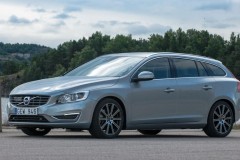
Volvo V60 2013 2.0 D4 technical data
| Model: | Volvo V60 2.0 D4 |
|---|---|
| Body style: | Estate car / wagon |
| Production period: | 2015. January ... 2018. December |
| Engine: | 1969 cm3 Diesel, 4 cylinders |
| CO2 emissions: | 101 g/km |
| Power: | 190 HP ON 4250 RPM |
| Torque: | 400 NM ON 1750 RPM |
| Gearbox: | Manual gearbox (6 gears) |
| Drive type: | Front wheel drive (FWD) |
| Maximum speed: | 225 km/h |
| Acceleration 0-100 km/h: | 7.7 seconds |
| Fuel consumption (l/100km): | 4.0 (combined) 4.3 (urban) 3.5 (highway) |
| Real fuel consumption: | 5.5 l/100km (42.8 MPG) by user reviews from various sources |
| Fuel tank capacity: | 67 litres (17.7 gallons) |
| Car dimensions: | 4.63m (length) 1.83m (width) 1.48m (height) |
| Turning diameter: | 11.9 meters |
| Ground clearance: | 136 mm (approximate, with standard suspension, unladen vehicle) |
| Seats: | 5 seats |
| Trunk capacity: | 430 litres |
| Trunk max capacity: | 1241 litres (with rear seats folded down, if possible) |
| Gross weight: | 2170 kg Net weight: 1616 kg Load capacity: 554 kg |
Volvo V60 2013 2.0 D4 engine D4204T14
Engine reliability and common problems:
The Volvo D4204T14 is a 2.0-liter four-cylinder diesel from the VEA engine family, equipped with a twin-turbo setup and producing around 190 hp. It is a modern and efficient engine designed for good fuel economy and strong performance. When properly maintained, it can reach roughly 300,000–350,000 km of service life, although it does have several typical weak points that owners should be aware of.One of the most common problems involves the rubber hoses in the turbocharging system. The pipes leading to the turbochargers and intercooler can crack over time, which results in power loss and often triggers warning messages. Oil leaks are also fairly typical. Seals and gaskets—particularly around the valve cover—may begin to seep oil, especially on early production engines from around 2015–2016, although some of these issues were improved in later updates.
Another part that tends to wear is the crankshaft pulley damper. As it deteriorates it can produce knocking or rustling noises, often becoming more noticeable in cold weather. The timing belt also requires attention, as its typical service life is about 120,000 km. If the belt fails, valve damage is almost inevitable.
Like many modern diesel engines, the D4204T14 is sensitive to the condition of its emissions system. The diesel particulate filter, intake system, and EGR components may become clogged over time, and there have been recall campaigns related to some of these parts. Because of this, oil quality and service intervals are especially important. Although official maintenance schedules may suggest longer intervals, many specialists recommend changing the oil every 10,000–15,000 km or even sooner.
Despite these shortcomings, the D4204T14 is generally considered a reliable engine within its class when maintained properly. Regular servicing, quality oil, and attention to the turbo system and emissions components are key to keeping it running smoothly over the long term.
Overall, this engine can last around 240,000 to 410,000 km if properly maintained, using the correct quality oil and fuel, and carrying out regular checks and maintenance.
| Engine displacement | 1969 cm3 |
|---|---|
| Number of cylinders | 4 |
| Bore (cylinder diameter) | 82 mm |
| Stroke length (piston move) | 93.2 mm |
| Compression ratio | 15.8 : 1 |
| Camshaft drive | Timing belt Timing belt engines are generally quieter and less vibrating than chain engines, but belt usually needs to be replaced more often and the risk of breakage is higher. More service info |
| Timing belt change interval | 120,000 km (recommended) Sometimes manufacturers do not specify timing chain replacement intervals and design chains for engine life. However, once the recommended change interval has been reached, it is recommended to periodically check the condition of the chain and to change the chain if excessive stretching is detected or if unusual noises from the engine or other symptoms occur. |
| Fuel system | Common Rail Common rail fuel injection provides more engine power, is quieter, more environmentally friendly and offers better fuel economy, but is more expensive to maintain and repair. |
| Volvo V60 2013 2.0 D4 oil type | 0W-20 |
| Oil capacity | 5.6 litres (5.9 quarts) More service info |
| Coolant capacity | 8.9 litres (9.4 quarts) |
| Power | 190 HP ON 4250 RPM |
| Torque | 400 NM ON 1750 RPM |
| Start of production (year) | 2014 |
| Duration of production | 12 years |
Often in the first years of production, engines tend to have various constructive problems, so it is recommended to choose a car with this engine from 2017 onwards. |
|
| Engine also used on | Volvo S60 Volvo XC90 Volvo V40 Volvo XC60 Volvo XC40 and 6 other models |
Generally, the use of an engine in several models and its long production run is an indication of the quality of the engine and the success of its design. |
All Volvo V60 estate car [2013 - 2018] modifications
| Modification | Engine | Power | Consumption | Gearbox | Drive type |
|---|---|---|---|---|---|
|
Volvo V60 2016 1.5 T2
Jan 2016 — Dec 2018 Most fuel efficient petrol version |
1.5 Petrol | 122 HP | 5.9 l/100km | Automatic (6) | Front wheel |
|
Volvo V60 2013 1.6 T3
Jan 2013 — Jan 2018 Most fuel efficient petrol version by real consumption |
1.6 Petrol | 150 HP | 6.0 l/100km | Manual (6) | Front wheel |
| Volvo V60 2013 1.6 T3 Jan 2013 — Jan 2018 | 1.6 Petrol | 150 HP | 7.2 l/100km | Automatic (6) | Front wheel |
| Volvo V60 2013 1.6 T4 Jan 2013 — Jan 2018 | 1.6 Petrol | 180 HP | 6.6 l/100km | Manual (6) | Front wheel |
| Volvo V60 2013 1.6 T4 Jan 2013 — Jan 2018 | 1.6 Petrol | 180 HP | 7.2 l/100km | Automatic (6) | Front wheel |
|
Volvo V60 2013 1.6 D2
Jan 2013 — Jan 2018 Most fuel efficient diesel version by real consumption |
1.6 Diesel | 115 HP | 4.1 l/100km | Manual (6) | Front wheel |
| Volvo V60 2013 1.6 D2 Jan 2013 — Jan 2018 | 1.6 Diesel | 115 HP | 4.2 l/100km | Automatic (6) | Front wheel |
| Volvo V60 2013 2.0 T5 Jan 2013 — Jan 2018 | 2.0 Petrol | 240 HP | 8.2 l/100km | Automatic (6) | Front wheel |
| Volvo V60 2013 2.0 T6 Jan 2013 — Jan 2018 | 2.0 Petrol | 306 HP | 6.7 l/100km | Automatic (8) | Front wheel |
|
Volvo V60 2016 Polestar 2.0 T6 4x4
Jan 2016 — Dec 2018 Most dynamic version - 100 km/h in 4.8 seconds |
2.0 Petrol | 367 HP | 8.1 l/100km | Automatic (8) | All wheel |
|
Volvo V60 2015 2.0 D2
Jan 2015 — Dec 2018 Most fuel efficient diesel version |
2.0 Diesel | 120 HP | 3.8 l/100km | Manual (6) | Front wheel |
| Volvo V60 2015 2.0 D2 Jan 2015 — Dec 2018 | 2.0 Diesel | 120 HP | 4.2 l/100km | Automatic (6) | Front wheel |
| Volvo V60 2013 2.0 D3 | 2.0 Diesel | 136 HP | 4.5 l/100km | Manual (6) | Front wheel |
| Volvo V60 2013 2.0 D3 | 2.0 Diesel | 136 HP | 4.9 l/100km | Automatic (6) | Front wheel |
| Volvo V60 2015 2.0 D3 Jan 2015 — Dec 2018 | 2.0 Diesel | 150 HP | 4.0 l/100km | Manual (6) | Front wheel |
| Volvo V60 2015 2.0 D3 Jan 2015 — Dec 2018 | 2.0 Diesel | 150 HP | 4.2 l/100km | Automatic (6) | Front wheel |
| Volvo V60 2013 2.0 D4 Jan 2013 — Jan 2018 | 2.0 Diesel | 163 HP | 4.5 l/100km | Manual (6) | Front wheel |
| Volvo V60 2013 2.0 D4 Jan 2013 — Jan 2018 | 2.0 Diesel | 163 HP | 4.9 l/100km | Automatic (6) | Front wheel |
| Volvo V60 2013 2.0 D4 Jan 2013 — Dec 2015 | 2.0 Diesel | 181 HP | 3.9 l/100km | Manual (6) | Front wheel |
| Volvo V60 2013 2.0 D4 Jan 2013 — Dec 2015 | 2.0 Diesel | 181 HP | 4.3 l/100km | Automatic (6) | Front wheel |
| Volvo V60 2015 2.0 D4 Jan 2015 — Dec 2018 | 2.0 Diesel | 190 HP | 4.0 l/100km | Manual (6) | Front wheel |
| Volvo V60 2015 2.0 D4 Jan 2015 — Dec 2018 | 2.0 Diesel | 190 HP | 4.4 l/100km | Automatic (8) | Front wheel |
|
Volvo V60 2015 2.0 D5
Jan 2015 — Dec 2018 Most powerfull diesel version (225 HP) |
2.0 Diesel | 225 HP | 4.8 l/100km | Automatic (8) | Front wheel |
| Volvo V60 2013 2.4 D5 Jan 2013 — Jan 2018 | 2.4 Diesel | 215 HP | 4.6 l/100km | Manual (6) | Front wheel |
| Volvo V60 2013 2.4 D5 Jan 2013 — Jan 2018 | 2.4 Diesel | 215 HP | 6.2 l/100km | Automatic (6) | Front wheel |
| Volvo V60 2013 2.4 D5 AWD Jan 2013 — Jan 2018 | 2.4 Diesel | 215 HP | 5.9 l/100km | Automatic (6) | All wheel |
| Volvo V60 2013 3.0 T6 AWD | 3.0 Petrol | 304 HP | 10.2 l/100km | Automatic (6) | All wheel |
| Volvo V60 2014 Polestar 3.0 T6 4x4 Jan 2014 — Dec 2015 | 3.0 Petrol | 350 HP | 10.2 l/100km | Automatic (6) | All wheel |