
Land Rover Range Rover Sport 2017 5.0 SVR
Land Rover Range Rover Sport 2017 5.0 petrol description
Land Rover Range Rover Sport 2017 5.0 SVR has been produced from 2017 to 2022. It has eight-cylinder petrol engine with displacement of 5.0 litres, which produces power of 575 horsepower at 6000 rpm - this is the most powerfull Land Rover Range Rover Sport 2017 - 2022 version and torque 700 Nm (Newton metres) on 2500 revolutions per minute.
This 8-cylinder 32-valve engine camshaft is driven by chain (What is an engine chain and belt? ). Engine has fuel injection system and Eaton M112 turbine. The engine meets the Euro 5 emissions standard. Approximate engine life expectancy (mileage until serious repairs are required) for this engine is between 270 000 and 450 000 kilometres. It is important to remember that engine life is highly dependent on regular maintenance and the quality of the oils and fuels used.
More engine specs
This Land Rover Range Rover Sport 5.0 engine oil type is 5W-20 and oil capacity is 8 litres.
Land Rover Range Rover Sport 2017 5.0 SVR has all four wheel drive (AWD, 4x4) and automatic gearbox with 8 gears.
Land Rover Range Rover Sport 2017 5.0 SVR accelerates to speed 100 kilometres per hour in 4.5 seconds. The maximum speed of this car is 283 km/h.
In combined cycle (city and motorway), the Land Rover Range Rover Sport 2017 5.0 SVR fuel consumption is 12.8 litres per 100km (7.8 km/l), city fuel economy - 18 l/100km, fuel consumption on highway - 9.9 l/100km. Fuel tank capacity is 104 litres or 27.48 gallons, which gives a mileage up to 800 kilometers without refueling in urban cycle and even up to 1040 kilometers on highway.
According to user reviews, this Land Rover real everyday fuel consumption is 16.2 litres per 100 km, which is 27% more than the manufacturer's stated. More - Real Land Rover Range Rover Sport fuel consumption.
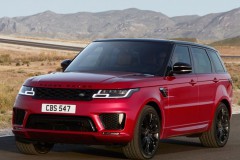
Land Rover Range Rover Sport 2017 5.0 SVR technical data
| Model: | Land Rover Range Rover Sport 5.0 SVR |
|---|---|
| Body style: | Crossover / SUV |
| Production period: | 2017. January ... 2022. December |
| Engine: | 4999 cm3 Petrol, 8 cylinders |
| CO2 emissions: | 294 g/km |
| Power: | 575 HP ON 6000 RPM |
| Torque: | 700 NM ON 2500 RPM |
| Gearbox: | Automatic gearbox (8 gears) |
| Drive type: | All wheel drive (AWD, 4x4) |
| Top speed: | 283 km/h |
| Acceleration 0-100 km/h: | 4.5 seconds |
| Fuel consumption (l/100km): | 12.8 (combined) 18.0 (urban) 9.9 (highway) |
| Real fuel consumption: | 16.2 l/100km (14.5 MPG) by user reviews from various sources |
| Fuel tank capacity: | 104 litres (27.5 gallons) |
| Car dimensions: | 4.88m (length) 2.07m (width) 1.80m (height) |
| Turning diameter: | 12.4 meters |
| Ground clearance: | 278 mm (approximate, with standard suspension, unladen vehicle) |
| Seats: | 5 seats |
| Trunk capacity: | 780 litres or 220 litres for version with 7 seats |
| Trunk max capacity: | 1686 litres (with rear seats folded down, if possible) |
| Gross weight: | 3000 kg Net weight: 2310 kg Load capacity: 690 kg |
Land Rover Range Rover Sport 2017 5.0 SVR engine 508PS
Engine reliability:
Overall, this engine can last around 270,000 to 450,000 km if properly maintained, using the correct quality oil and fuel, and carrying out regular checks and maintenance.| Engine displacement | 4999 cm3 |
|---|---|
| Number of cylinders | 8 |
| Bore (cylinder diameter) | 92.5 mm |
| Stroke length (piston move) | 93 mm |
| Compression ratio | 9.5 : 1 |
| Camshaft drive | Timing chain Chain motors are considered more reliable, chain replacement usually is required less often than a timing belt, but they are often louder and vibrate more. |
| Fuel system | Injection |
| Land Rover Range Rover Sport 2017 5.0 SVR oil type | 5W-20 |
| Oil capacity | 8 litres (8.5 quarts) |
| Coolant capacity | 8.83 litres (9.3 quarts) |
| Power | 450 - 600 HP ON 6000 RPM |
| Torque | 575 - 700 NM ON 2500 RPM |
| Start of production (year) | 2009 |
| Duration of production | 17 years |
| Engine also used on | Land Rover Range Rover Jaguar XJ |
Generally, the use of an engine in several models and its long production run is an indication of the quality of the engine and the success of its design. |
All Land Rover Range Rover Sport crossover [2017 - 2022] modifications
| Modification | Engine | Power | Consumption |
|---|---|---|---|
|
Land Rover Range Rover Sport 2017 2.0 Si 4x4
Jan 2017 — Dec 2021 Most fuel efficient petrol version |
2.0 Petrol | 300 HP | 9.2 l/100km |
| Land Rover Range Rover Sport 2017 2.0 P400e 4x4 | 2.0 Hybrid PHEV |
300 HP | 2.8 l/100km |
| Land Rover Range Rover Sport 2017 3.0 4x4 Jan 2017 — Dec 2018 | 3.0 Petrol | 340 HP | 10.5 l/100km |
|
Land Rover Range Rover Sport 2019 3.0 P360 MHEV 4x4
Jan 2019 — Dec 2022 Most fuel efficient petrol version |
3.0 Petrol MHEV hybrid engine |
360 HP | 9.2 l/100km |
|
Land Rover Range Rover Sport 2019 3.0 P360 MHEV 4x4
Jan 2019 — Dec 2022 Most fuel efficient petrol version |
3.0 Petrol MHEV hybrid engine |
360 HP | 9.2 l/100km |
| Land Rover Range Rover Sport 2019 3.0 P400 MHEV 4x4 Jan 2019 — Dec 2022 | 3.0 Petrol MHEV hybrid engine |
400 HP | 11.7 l/100km |
| Land Rover Range Rover Sport 2019 3.0 P400 MHEV 4x4 Jan 2019 — Dec 2022 | 3.0 Petrol MHEV hybrid engine |
400 HP | 11.7 l/100km |
|
Land Rover Range Rover Sport 2017 3.0 TD 4x4
Jan 2017 — Dec 2020 Most fuel efficient diesel version |
3.0 Diesel | 249 HP | 6.9 l/100km |
| Land Rover Range Rover Sport 2017 3.0 SD 4x4 Jan 2017 — Dec 2018 | 3.0 Diesel | 306 HP | 7.0 l/100km |
|
Land Rover Range Rover Sport 2017 4.4 SD 4x4
Jan 2017 — Dec 2020 Most powerfull diesel version (339 HP) |
4.4 Diesel | 339 HP | 8.6 l/100km |
| Land Rover Range Rover Sport 2017 5.0 4x4 | 5.0 Petrol | 525 HP | 12.8 l/100km |
|
Land Rover Range Rover Sport 2017 5.0 SVR 4x4
Most dynamic version - 100 km/h in 4.5 seconds |
5.0 Petrol | 575 HP | 12.8 l/100km |