
Hyundai i30 2008 CW 2.0 CRDi
Hyundai i30 2008 2.0 diesel description
Estate car / wagon Hyundai i30 2008 CW 2.0 CRDi has been produced from 2008 to 2010. It has four-cylinder diesel engine with displacement of 2.0 litres, which produces power of 140 horsepower on 3800 rpm and torque 304 Nm (Newton metres) on 1900 revolutions per minute.
This 4-cylinder 16-valve engine camshaft is driven by belt (What is an engine chain and belt? ). Engine has Common Rail fuel system without turbocharger. Engine versions compliant with Euro 3 and Euro 4 emission standards available.
More engine specs
The Hyundai/Kia 2.0 CRDi engine with the D4EA code is a cast-iron diesel unit introduced in the early 2000s. It is known for solid durability and, when properly maintained, can often reach 300,000–400,000 km. The engine appeared in several versions over the ...
This Hyundai i30 2.0 engine oil type is 5W-30, 5W-40 and oil capacity is 6.5 litres.
Hyundai i30 2008 CW 2.0 CRDi has front wheel drive (FWD) and manual gearbox with 6 gears.
Hyundai i30 2008 CW 2.0 CRDi accelerates to speed 100 kilometres per hour in 10.3 seconds. The maximum speed of this car is 205 km/h.
The fuel consumption of this Hyundai i30 2008 CW 2.0 CRDi in combined mode (combining urban and highway driving) is 5.5 litres per 100km (18.2 km/l) - this is one of most fuel efficient Hyundai i30 2008 - 2010 versions, fuel consumption in city - 7.2 l/100km, highway fuel economy - 4.4 l/100km. Fuel tank capacity is 53 litres or 14 gallons, which gives a mileage up to 960 kilometers without refueling in urban cycle and even up to 1200 kilometers on highway.
According to user reviews, this Hyundai real everyday fuel consumption is 6.5 litres per 100 km, which is 18% more than the manufacturer's stated. More - Real Hyundai i30 fuel consumption.
Hyundai i30 safety
During safety testing Hyundai i30 has obtained 5 stars from five, which means very high safety level.
Adults (driver and passenger) safety of Hyundai i30 is evaluated with five stars, children safety - with four stars, and for pedestrian protection Hyundai i30 got two stars.
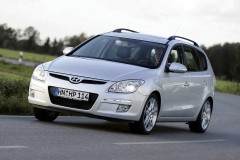
Hyundai i30 2008 CW 2.0 CRDi technical data
| Model: | Hyundai i30 CW 2.0 CRDi | ||
|---|---|---|---|
| Body style: | Estate car / wagon | ||
| Production period: | 2008. January ... 2010. January | ||
| Engine: | 1991 cm3 Diesel, 4 cylinders | CO2 emissions: | 145 g/km |
| Power: | 140 HP ON 3800 RPM | Torque: | 304 NM ON 1900 RPM |
| Gearbox: | Manual gearbox (6 gears) | Drive type: | Front wheel drive (FWD) |
| Maximum speed: | 205 km/h | Acceleration 0-100 km/h: | 10.3 seconds |
| Fuel consumption (l/100km): | 5.5 (combined) 7.2 (urban) 4.4 (highway) | ||
| Real fuel consumption: | 6.5 l/100km (36.2 MPG) by user reviews from various sources | ||
| Fuel tank capacity: | 53 litres (14 gallons) | ||
| Car dimensions: | 4.48m (length) 1.78m (width) 1.52m (height) | ||
| Turning diameter: | 10.2 meters | ||
| Trunk capacity: | 415 litres | ||
| Trunk max capacity: | 1395 litres (with rear seats folded down, if possible) | ||
| Gross weight: | 1970 kg Net weight: 1381 kg Load capacity: 589 kg | ||
Hyundai i30 2008 CW 2.0 CRDi engine D4EA
Engine reliability and common problems:
The Hyundai/Kia 2.0 CRDi engine with the D4EA code is a cast-iron diesel unit introduced in the early 2000s. It is known for solid durability and, when properly maintained, can often reach 300,000–400,000 km. The engine appeared in several versions over the years. Early variants produced around 112 hp with a conventional MHI turbocharger, while the D4EA-V version used a Garrett variable-geometry turbo and delivered about 125 hp. A later (2005) update introduced more powerful versions with 140–150 hp, along with an improved Bosch common-rail fuel system operating at higher pressure and a more advanced Garrett turbocharger.In everyday use the engine is fairly economical for its size and generally straightforward to service, with good availability of spare parts. The cylinder head also includes hydraulic lifters, which simplifies maintenance. However, several weak points are known and require attention.
The fuel system can be sensitive to diesel quality. Injectors and the fuel pressure regulator may fail if contaminated fuel is used, leading to rough running or misfires. Another known concern involves the piston assembly. In some cases incorrect combustion timing can cause damage to piston rings or even the piston crown, particularly in early engines.
Wear in the valvetrain is another area to watch. Hydraulic lifters may fail and cause damage to the rocker arms, while camshaft wear is also reported on higher-mileage engines. The timing belt must be monitored carefully, as a failure will almost always result in bent valves and major repair costs.
Oil-related problems may also occur if maintenance is neglected. A clogged oil pump pickup can lead to oil starvation and bearing damage. After about 200,000–250,000 km some engines begin to show increased oil consumption, and components such as the turbocharger or camshafts may require replacement.
Despite these issues, the D4EA is generally regarded as a durable diesel engine. Regular maintenance—particularly timely timing belt replacement every 60,000–80,000 km, the use of good-quality oil, and careful attention to the fuel system—greatly improves its long-term reliability.
The engine has hydraulic valve tappets (lifters), which provide quieter operation and do not require periodic adjustment, but are more complex in design and can cause serious engine damage in the event of failure.
| Engine displacement | 1991 cm3 |
|---|---|
| Number of cylinders | 4 |
| Bore (cylinder diameter) | 83 mm |
| Stroke length (piston move) | 92 mm |
| Compression ratio | 17.3 : 1 |
| Camshaft drive | Timing belt Timing belt engines are generally quieter and less vibrating than chain engines, but belt usually needs to be replaced more often and the risk of breakage is higher. More service info |
| Timing belt change interval | 90,000 km (specified), 60,000 km (recommended) |
| Fuel system | Common Rail Common rail fuel injection provides more engine power, is quieter, more environmentally friendly and offers better fuel economy, but is more expensive to maintain and repair. |
| Hyundai i30 2008 CW 2.0 CRDi oil type | 5W-30, 5W-40 |
| Oil capacity | 6.5 litres (6.9 quarts) More service info |
| Power | 112 - 150 HP ON 3800 RPM |
| Torque | 235 - 305 NM ON 1900 RPM |
| Start of production (year) | 2001 |
| Duration of production | 11 years |
| Engine also used on | Hyundai Santa FE Kia Sportage Kia Ceed Hyundai Sonata Hyundai Tucson and 6 other models |
Generally, the use of an engine in several models and its long production run is an indication of the quality of the engine and the success of its design. |
Most often compared to
All Hyundai i30 estate car [2008 - 2010] modifications
| Modification | Engine | Power | Consumption | Gearbox |
|---|---|---|---|---|
|
Hyundai i30 2008 CW 1.4i
Most fuel efficient petrol version |
1.4 Petrol | 109 HP | 5.8 l/100km | Manual (5) |
|
Hyundai i30 2008 CW 1.6i
Most fuel efficient petrol version by real consumption |
1.6 Petrol | 126 HP | 6.2 l/100km | Manual (5) |
| Hyundai i30 2008 CW 1.6i | 1.6 Petrol | 126 HP | 6.9 l/100km | Automatic (4) |
|
Hyundai i30 2008 CW 1.6 CRDi
Most fuel efficient diesel version |
1.6 Diesel | 90 HP | 4.9 l/100km | Manual (5) |
|
Hyundai i30 2008 CW 1.6 CRDi
Most fuel efficient diesel version |
1.6 Diesel | 115 HP | 4.9 l/100km | Manual (5) |
| Hyundai i30 2008 CW 1.6 CRDi | 1.6 Diesel | 115 HP | 6.0 l/100km | Automatic (4) |
|
Hyundai i30 2008 CW 2.0i
Most powerfull petrol version (143 HP) |
2.0 Petrol | 143 HP | 7.1 l/100km | Manual (5) |
|
Hyundai i30 2008 CW 2.0i
Most powerfull petrol version (143 HP) |
2.0 Petrol | 143 HP | 7.6 l/100km | Automatic (4) |
|
Hyundai i30 2008 CW 2.0 CRDi
Most dynamic version - 100 km/h in 10.3 seconds |
2.0 Diesel | 140 HP | 5.5 l/100km | Manual (6) |