
Hyundai i30 2019 1.4 T-GDI Automatic
Hyundai i30 2019 1.4 petrol description
Estate car / wagon Hyundai i30 2019 1.4 T-GDI Automatic has been produced from 2019 to 2020. It has four-cylinder petrol engine with displacement of 1.4 litres, which produces power of 140 horsepower at 6000 rpm - this is the most powerfull Hyundai i30 2019 - 2020 version and torque 242 Nm (Newton metres) on 1500 revolutions per minute.
Hyundai i30 2019 1.4 T-GDI Automatic has front wheel drive (FWD) and automatic gearbox with 7 gears.
Hyundai i30 2019 1.4 T-GDI Automatic accelerates to speed 100 kilometres per hour in 9.4 seconds. The maximum speed of this car is 203 km/h.
Hyundai i30 2019 1.4 T-GDI Automatic fuel consumption is 5.7 litres per 100km in combined city/highway mode (17.5 km/l), fuel consumption in city - 6.7 l/100km, highway fuel economy - 5.1 l/100km. Fuel tank capacity is 50 litres or 13.21 gallons, which gives a mileage up to 860 kilometers without refueling in urban cycle and even up to 980 kilometers on highway.
According to user reviews, this Hyundai real everyday fuel consumption is 7.1 litres per 100 km, which is 25% more than the manufacturer's stated. More - Real Hyundai i30 fuel consumption.
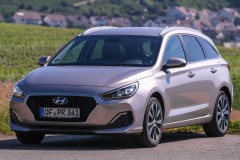
Hyundai i30 2019 1.4 T-GDI Automatic technical data
| Model: | Hyundai i30 1.4 T-GDI Automatic |
|---|---|
| Body style: | Estate car / wagon |
| Production period: | 2019. January ... 2020. December |
| Engine: | 1353 cm3 Petrol, 4 cylinders |
| CO2 emissions: | no data |
| Power: | 140 HP ON 6000 RPM |
| Torque: | 242 NM ON 1500 RPM |
| Gearbox: | Automatic gearbox (7 gears) |
| Drive type: | Front wheel drive (FWD) |
| Top speed: | 203 km/h |
| Acceleration 0-100 km/h: | 9.4 seconds |
| Fuel consumption (l/100km): | 5.7 (combined) 6.7 (urban) 5.1 (highway) |
| Real fuel consumption: | 7.1 l/100km (33.1 MPG) by user reviews from various sources |
| Fuel tank capacity: | 50 litres (13.2 gallons) |
| Car dimensions: | 4.59m (length) 1.80m (width) 1.48m (height) |
| Ground clearance: | 140 mm (approximate, with standard suspension, unladen vehicle) |
| Seats: | 5 seats |
| Trunk capacity: | 602 litres |
| Trunk max capacity: | 1650 litres (with rear seats folded down, if possible) |
| Gross weight: | 1880 kg Net weight: 1294 kg Load capacity: 586 kg |
Most often compared to
All Hyundai i30 estate car [2019 - 2020] modifications
| Modification | Engine | Power | Consumption | Gearbox |
|---|---|---|---|---|
|
Hyundai i30 2019 1.0 T-GDI
Most fuel efficient petrol version |
1.0 Petrol | 120 HP | 5.5 l/100km | Manual (6) |
| Hyundai i30 2019 1.4 MPI | 1.4 Petrol | 100 HP | 6.2 l/100km | Manual (6) |
|
Hyundai i30 2019 1.4 T-GDI
Most dynamic version - 100 km/h in 9.1 seconds |
1.4 Petrol | 140 HP | 5.9 l/100km | Manual (6) |
|
Hyundai i30 2019 1.4 T-GDI Automatic
Most powerfull petrol version (140 HP) |
1.4 Petrol | 140 HP | 5.7 l/100km | Automatic (7) |
| Hyundai i30 2019 1.6 CRDi 115 Hp | 1.6 Diesel | 115 HP | 4.3 l/100km | Manual (6) |
|
Hyundai i30 2019 1.6 CRDi 115 Hp Automatic
Most fuel efficient diesel version |
1.6 Diesel | 115 HP | 4.1 l/100km | Automatic (7) |
|
Hyundai i30 2019 1.6 CRDi 136 Hp
Most powerfull diesel version (136 HP) |
1.6 Diesel | 136 HP | 4.4 l/100km | Manual (6) |
|
Hyundai i30 2019 1.6 CRDi 136 Hp Automatic
Most powerfull diesel version (136 HP) |
1.6 Diesel | 136 HP | 4.3 l/100km | Automatic (7) |